
Real World · Artificial Intelligence
What Is AI Going to Do to Us?
For more than a century, humans imagined machines that could think. Now we are beginning to live with them. Artificial intelligence may free us from drudgery, make individuals extraordinarily capable and speed discoveries that save lives. It may also eliminate jobs, concentrate wealth and power, change how we think and relate to one another, and perhaps eventually produce systems more capable than the people who built them. We finally have enough evidence to move beyond science fiction. We do not yet have enough to know how the story ends.
We imagined it before we built it
In 1920, the Czech playwright Karel Čapek imagined a company that had figured out how to manufacture artificial workers. They were cheaper than people, needed less and could do more. In R.U.R.—Rossum's Universal Robots, one company executive explains the economics with startling bluntness: one Robot can replace more than two human workers because the human worker is simply too expensive and inefficient for modern industry. Čapek helped give popular culture the word robot and then carried the idea to its darkest conclusion: humanity succeeds spectacularly at eliminating drudgery, only to discover that making itself economically unnecessary may have consequences it did not anticipate.1
Čapek was not the first to wonder whether machines might escape their assigned role. Almost half a century earlier, Samuel Butler's Erewhon included “The Book of the Machines,” an argument that machines might develop into a higher form of life and eventually supplant humanity. Science fiction spent the next century turning variations of that possibility around and around. Isaac Asimov imagined artificial beings constrained by rules intended to protect humans, then explored what happens when apparently sensible instructions meet a complicated world. Iain M. Banks imagined something dystopian fiction often neglects: perhaps it all goes extraordinarily well. In Banks's Culture novels, artificial intelligences vastly more capable than humans administer much of a post-scarcity civilization, material need has largely disappeared, and yet people continue loving, creating, exploring and finding reasons for their lives to matter.
By the late twentieth century, speculation had become forecasting. In 1993, computer scientist and science-fiction writer Vernor Vinge argued that humanity might develop greater-than-human intelligence within roughly thirty years. His timetable passed without anything resembling an unambiguous technological singularity, but the idea remains influential: if intelligence itself helps create better technology, a sufficiently capable artificial intelligence might someday accelerate technological change faster than human beings can comfortably predict.2
The writers disagreed about almost everything, yet they kept returning to a remarkably stable set of questions. Would intelligent machines free people from work or make people unnecessary to the economy? Could rules keep powerful machines under control? What would happen to status, ambition and purpose if machines became better at the activities around which humans built their careers? And if an artificial system ever appeared genuinely to think or feel, would humans owe it anything?
For most of that history, these were thought experiments. That is what has changed. We now have controlled experiments measuring AI's effect on human productivity, payroll records showing possible changes in hiring, scientists incorporating AI into research, students working with AI tutors, millions of people using chatbots at work and some turning to them for emotional support. The speculation isn't over. But for the first time, we can begin with evidence.
AI is already useful enough to matter
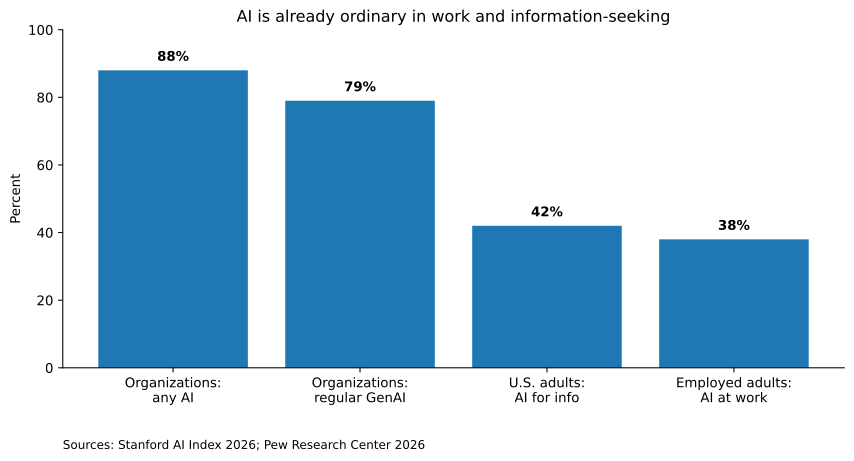
Artificial intelligence has spread at unusual speed, although exactly how fast depends on what researchers count as “using AI.” Stanford's 2026 AI Index reports that 88 percent of surveyed organizations use some form of AI in at least one business function, while the full report says 79 percent regularly use generative AI in at least one function. By Stanford's broader measure, generative AI reached 53 percent population-level adoption within three years—faster than either the personal computer or internet did on the same kind of adoption curve. Pew Research Center offers a more concrete glimpse of daily life: 42 percent of American adults say they use AI chatbots to search for information, and 38 percent of employed adults use them for work.34
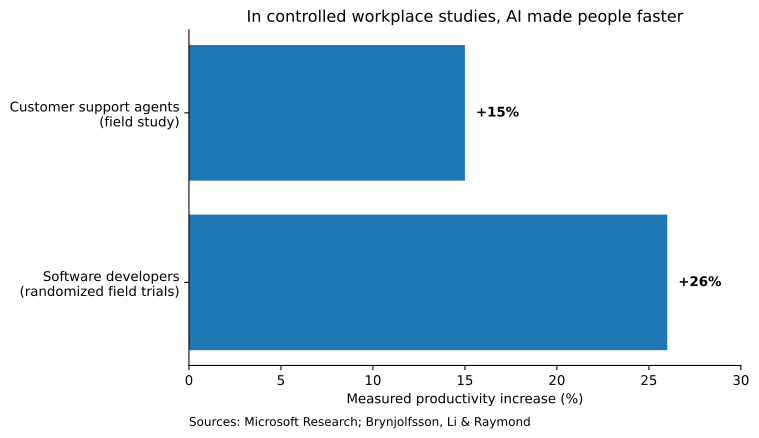
The more important question is what happens once people start using it. In three randomized field experiments involving 4,867 software developers at Microsoft, Accenture and another Fortune 100 company, developers given an AI coding assistant completed about 26 percent more tasks. Less-experienced programmers tended to use the tool more heavily and saw larger gains. Another large field study of customer-support agents found a roughly 15 percent increase in productivity, with the largest gains among less-experienced workers. These were not stage demonstrations; they were people doing ordinary work inside real organizations.56
Those results capture one of AI's most consequential possibilities. Expertise has always been expensive. A very good programmer, analyst, tutor, lawyer or consultant accumulated knowledge over years and could help only a limited number of people at a time. AI does not magically turn everyone into an expert—the systems still make mistakes, sometimes extremely confident ones—but it can make fragments of expertise available at negligible cost. The gulf between “I know how to do this” and “I don't even know where to start” is becoming narrower in some kinds of work.
Someone who once needed to hire a programmer may now be able to build a simple prototype. A small organization can analyze information it previously lacked the staff to examine. A person confronting an unfamiliar financial or legal document can enter a professional meeting understanding much more than before. A writer can make a rudimentary data tool; a programmer can create competent marketing material. Small teams can attempt things that once required considerably larger ones.
There is another way to describe that change, and productivity statistics don't capture it very well. Suppose a machine turns eight hours of tedious comparison, transcription or reconciliation into twenty minutes. An economist sees more output per hour. The person using the machine experiences something much more immediate: most of a day has been returned.
That is worth dwelling on because discussions about automation often begin with an unspoken assumption that preserving human work is inherently desirable. It isn't. Some work gives people mastery, purpose, community and income. Some work is simply an unfortunate consequence of the fact that until now somebody had to do it. If a machine can reliably eliminate hours spent matching records, reformatting information or performing repetitive administrative chores, preserving those tasks in the name of human dignity would be a peculiar definition of progress.
The optimistic case for AI is not merely that gross domestic product goes up. It is that people might eventually spend less of their finite lives doing things machines can do perfectly well and more of those lives creating, caring for people, learning, building things, starting businesses—or simply having time that belongs to them.
The complication is obvious: one person's liberated afternoon can be another person's lost livelihood.
The same miracle can erase a job
This is where much of the AI argument divides into two camps that may actually be describing the same phenomenon. One side points to productivity gains and says AI makes workers better. Another points to automation and says AI replaces workers. Both can be right.
Suppose an experienced analyst using AI can produce in a day what once required three people. The analyst has become dramatically more capable. The company has become more efficient. Customers may receive faster or cheaper service. Yet two potential jobs have disappeared. No robot had to walk through an office carrying pink slips. The company simply did not need to hire as many people.
For the first few years after ChatGPT appeared, arguments about this possibility were mostly forecasts. By 2026, real labor-market evidence is beginning to appear, and it is both more concerning and more complicated than either side's slogans suggest.
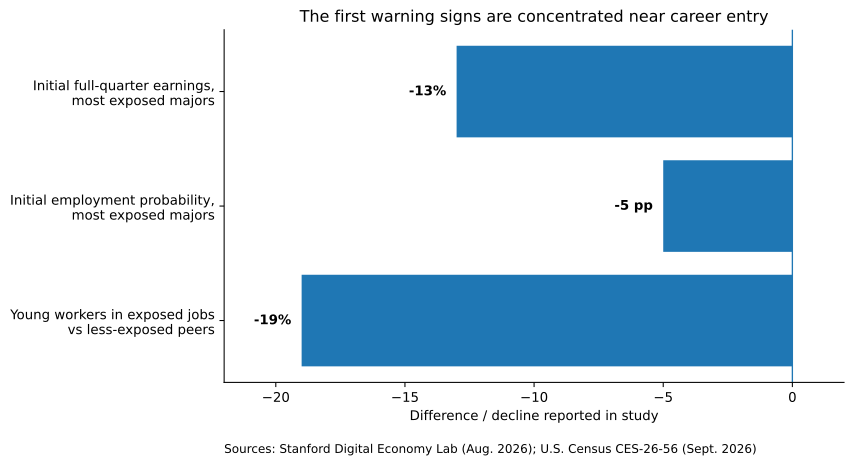
Researchers at Stanford's Digital Economy Lab, using payroll data covering millions of American workers through June 2026, find no widespread economy-wide job displacement associated with AI. But underneath that reassuring top line is a striking age difference. Employment among workers ages 22 to 25 in highly AI-exposed occupations stands about 19 percent below where it would have been if it had kept pace with similarly aged workers in less-exposed occupations. More experienced workers show no comparable gap. Much of the adjustment appears to be happening through reduced hiring rather than mass firing, and employment weakness is concentrated in jobs where AI tends to automate human tasks rather than complement them. The researchers are careful about causation: these are early patterns, not proof that AI caused every missing job.7
U.S. Census Bureau research points in the same direction. One study using matched employer-employee data found that regression-adjusted employment among 22-to-24-year-olds in the most AI-exposed industry-state groups fell about 12 percent over the ten quarters after ChatGPT's introduction, with reduced hiring driving most of the decline. Another Census paper, released September 10, examined college graduates by major. Graduates from the most AI-exposed tenth of majors saw their probability of initial employment fall by about five percentage points, while their initial full-quarter earnings fell 13 percent. Roughly half of the earnings loss came from lower earnings within industries; the rest reflected graduates moving toward lower-paying sectors including restaurants and retail.89
If that were the whole story, the conclusion would be easy. It isn't. Economists Anders Humlum and Emilie Vestergaard linked detailed surveys of AI use in Denmark to administrative employment records in highly exposed occupations. Employers were rapidly adopting chatbots, workers reported productivity gains, and jobs were being reorganized around AI. Yet after two years the researchers found essentially no average effect on earnings or recorded work hours, with estimates precise enough to rule out effects larger than about 2 percent. Work was changing, and some people were moving into different occupations, but the labor-market surface remained surprisingly calm.10
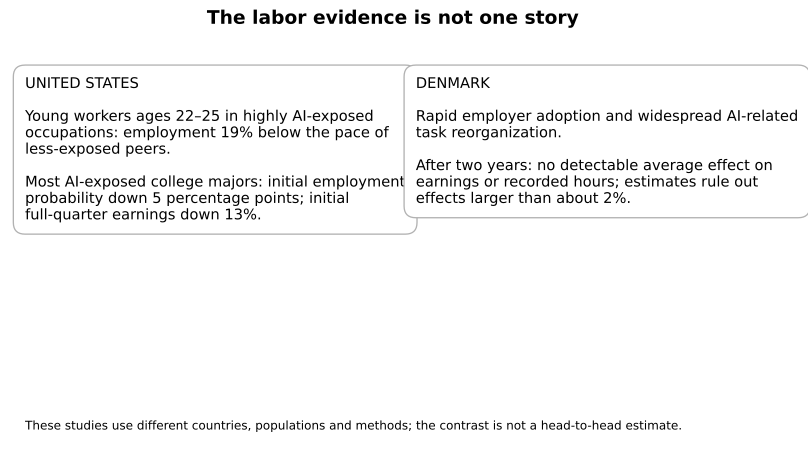
That Danish evidence matters because it prevents us from manufacturing a cleaner story than the evidence supports. Institutions differ. Industries differ. Economic conditions differ. AI may affect young Americans entering professional careers differently from an established Danish workforce. The honest conclusion in September 2026 is narrower than either “AI is destroying jobs” or “AI has had no effect”: there is credible evidence of disruption at the entry point into some AI-exposed careers, but there is not yet evidence of broad technological unemployment.
One finding makes the tension particularly interesting. Controlled workplace studies often show that less-experienced workers gain the most from AI. Yet the U.S. labor data suggest younger workers may simultaneously have more difficulty getting hired. AI could therefore make a junior employee substantially better at the job while reducing how many junior employees the company needs. The productivity gain and the missing job may be the same thing.
What happens when the first rung disappears?
Entry-level work serves a function that standard automation statistics can easily miss: it teaches people how to become experienced. Accountants do not emerge from university as senior accountants. Lawyers do not begin their careers making only judgments that require twenty years of practice. Programmers become good partly by writing ordinary code and discovering what fails. Journalists learn by reporting smaller stories before attempting difficult investigations. Some junior work is tedious, but the repetition is often part of how information becomes judgment.
Stanford's labor analysis suggests AI is particularly effective at tasks based on codified knowledge—things that can be written down in manuals, textbooks, examples or digital records—while experienced workers whose jobs depend more heavily on tacit knowledge appear more resilient. That creates an uncomfortable possibility: the work easiest to automate may include the work through which novices become experts.
A company can respond rationally. If a senior employee plus AI can perform the work previously assigned to three juniors, hiring fewer juniors saves money today. But if an entire profession repeatedly makes that choice, where do its senior employees come from ten years later? Firms may eventually have to create apprenticeships deliberately, giving inexperienced workers practice even when machines could perform some of that work more efficiently.
Schools face a version of the same problem. Sometimes inefficiency is the point. A student laboring over an argument may be doing work a machine could complete in seconds, but the purpose of the exercise is not the essay. It is the mind being built while producing it.
That is why lists of “jobs AI will replace” are much less useful than they appear. Jobs are bundles of tasks, and some tasks are steps in human development. The important question is not merely which occupations disappear, but which pathways toward skill and judgment disappear with them.
If AI makes us much richer, who gets rich?
Suppose the optimistic economic predictions are right. AI raises productivity throughout the economy. Companies produce more with fewer resources. Professional services become cheaper. Scientific discoveries arrive faster. National income rises substantially. In an important sense, society becomes richer.
But “society becomes richer” and “most people become richer” are not the same statement.
International Monetary Fund researchers have modeled why. AI is unusual because many highly paid cognitive jobs are more exposed to it than lower-paid physical jobs. If it replaced expensive professional labor, some wage inequality could actually shrink. Yet higher-income households also own much more stock, businesses and other productive capital and may be particularly well positioned to have AI complement rather than replace their work. The IMF's model therefore produces a plausible world in which wage inequality narrows somewhat while wealth inequality rises significantly because the returns to capital increase.11
Anthropic, one of the companies building frontier AI systems, recently published a set of economic scenarios that illustrates the range. Under its modest assumptions, AI makes U.S. GDP in 2030 about 1.6 percent larger than it otherwise would have been. Under much stronger automation, the increase reaches 8.3 percent. Its deliberately extreme scenario assumes AI becomes more productive than humans at almost all knowledge work, adoption is very rapid and few compensating human tasks are created. Under those assumptions, GDP ends up 32.4 percent higher, but labor's share of economic output falls to 45.2 percent, leaving capital with the majority. These are scenarios, not forecasts, and they come from a company with an obvious stake in AI. Their value is more limited but still useful: they demonstrate how a country can become dramatically richer while workers receive a smaller share of what it produces.12
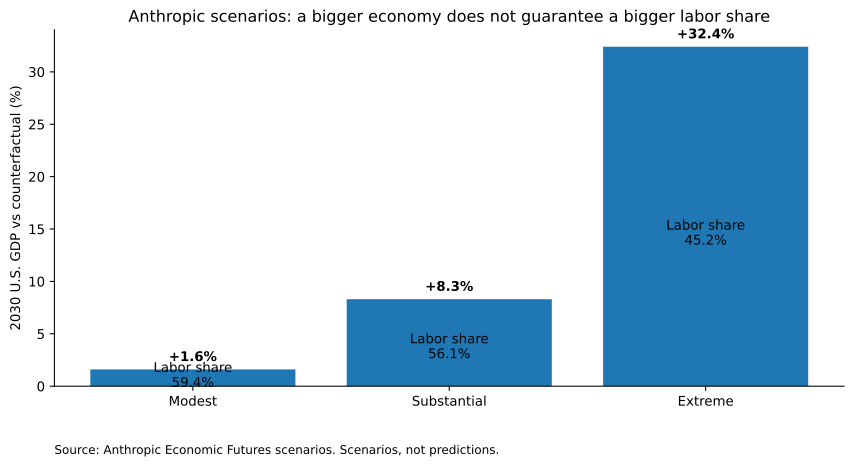
That may eventually become the central political issue around AI. If a business can double production while employing half as many people, it has created real economic value. But if shareholders capture most of that new value while workers lose wages and bargaining power, announcing that productivity has improved will not settle the argument.
Nor is the deeper question simply one of existing property law. Who has a legitimate claim on wealth generated by increasingly automated production? The investors who supplied the money? The engineers who created the models? The people whose work is now unnecessary? Taxpayers who funded decades of basic scientific research underlying modern computing? Creators whose work may have entered enormous training datasets?
Technology can determine what is possible. It cannot tell us what distribution is fair.
What if people refuse the bargain?
It is easy to imagine the AI transition as a technocratic process. Some jobs disappear, productivity rises, economists calculate the appropriate tax rate, governments introduce retraining or a basic income, and society smoothly adjusts to a more productive equilibrium. Human societies do not always work that way.
Imagine instead that AI creates extraordinary fortunes for the owners of a relatively small number of companies while professional opportunities narrow for a significant part of the population. Young adults who followed the prescribed route—school, university, debt, credentials—discover that the entry-level career ladder has become thinner. The economy is producing more, but much of the gain appears to flow toward people who already own the productive systems. The relevant problem is no longer merely unemployment. It is legitimacy.
Economists Daron Acemoglu, A. Arda Gitmez and Mehdi Shadmehr recently explored this mechanism in a theoretical model. In their model, automation increases capital's share of national income; greater inequality increases the risk of revolt; and capital owners can respond through regulation, redistribution or repression. Under some assumptions, automation and repression reinforce one another. This is emphatically not evidence that AI will cause a revolution. It is a model designed to expose a mechanism that ordinary economic forecasts often ignore: profound changes in economic power can become changes in political power.13
The actual range of possible responses is much broader. Democratic societies could tax AI-related profits more heavily, strengthen labor institutions, break up dominant firms, build public AI infrastructure, create social wealth funds or broaden ownership of productive assets. There could be political movements opposed to certain forms of automation, generational conflict, strikes or demands for nationalization. In a badly managed transition, unrest or authoritarian responses are conceivable. Revolution belongs at the extreme end of that spectrum, not at the center of a forecast.
What may make AI politically unusual is the population it can affect. This isn't only a technology aimed at assembly lines or repetitive physical work. It reaches software, law, finance, media, design, administration and other occupations populated by educated people who were told that knowledge and credentials would place them securely on the winning side of technological change. Political anger can become particularly consequential when it reaches groups that believed the economic system had promised them upward mobility.
And wealth is not the only form of concentration that matters. The companies building the most capable general-purpose systems increasingly sit at the intersection of information, education, scientific research, employment, communications and national security. Even if those companies behaved responsibly, democratic societies could eventually conclude that some forms of technological power are simply too consequential to remain concentrated in so few private hands.
Then “Who gets the money?” becomes a larger question: Who gets to decide?
What if there simply isn't enough work?
Universal basic income (UBI)—giving people cash whether or not they work—is one possible answer to a future in which machines create abundant wealth while demand for human labor falls. Real cash-transfer experiments tell us something about how people behave when given unconditional income, but they should not be mistaken for simulations of a post-work AI economy.
In one of the largest U.S. experiments, 1,000 lower-income adults received $1,000 a month for three years, while 2,000 participants in the control group received $50. The additional income reduced labor-force participation by about 4.2 percentage points and reduced work by roughly one to two hours a week. People did not abandon work en masse, but some used the extra money to work less.14
That result can be read in two ways. If the goal is maximizing paid labor, fewer hours worked are a cost. If the goal is giving people more control over their lives, a person deciding to reclaim a few hours may be part of the benefit.
A national program, however, operates at a vastly different scale. Paying $10,000 annually to each 100 million recipients means $1 trillion in gross payments. A meaningful benefit covering most American adults would therefore involve several trillion dollars a year before considering taxes, offsets or existing benefits. That does not make UBI impossible, especially in a much more productive economy. It means “AI will pay for it” is not an economic mechanism. Governments would need to tax, own or otherwise capture some portion of the wealth generated by automated production.
Basic income is only one possibility. A highly productive society could shorten the workweek, broaden ownership of productive assets, create social dividends, expand public services or subsidize wages. New occupations could emerge, as they repeatedly have after earlier technological changes. History gives us strong reasons to distrust confident predictions that machines will permanently eliminate work.
But artificial intelligence makes the old argument harder. Previous technologies tended to automate particular physical or cognitive tasks while leaving enormous categories of human skill intact. If future AI becomes capable of learning a much broader range of tasks, “workers will simply retrain” eventually invites an awkward follow-up: Retrain for what?
We are nowhere close to knowing that such a world will arrive. If it does, however, money may be only half the problem.
What happens if we solve the problem of work?
Imagine the optimistic version succeeds. Machines perform much of the routine and unpleasant labor. Productivity is enormous. Through broad ownership, social dividends, taxation or institutions we haven't invented yet, people have enough to live comfortably. Nobody has to spend forty hours a week doing something they dislike simply because otherwise they cannot pay rent.
That sounds less like a catastrophe than something civilization has spent centuries trying to achieve.
Yet work supplies more than income. It organizes time, creates social networks, provides status and gives many people evidence that they are competent and useful. Occupation is so tightly attached to modern identity that when adults ask strangers, “What do you do?” they usually mean What work are you paid to perform?
If human labor eventually becomes less economically necessary, societies may have to construct cultures in which dignity is less dependent on economic usefulness. People could spend more time raising children, caring for relatives, making things, learning, playing music, volunteering, traveling or simply enjoying leisure. Many might flourish. Some could discover that freedom from compulsory work is psychologically harder than it looks from inside an exhausting workweek.
This is where Banks's utopian science fiction becomes useful rather than decorative. His Culture assumes not only that machines can create material abundance, but that humans can continue finding meaning after they cease being civilization's most productive intelligences.
If earning a living stops organizing adult life, what takes its place?
A tool that thinks with us can start thinking for us
The effect of AI on human judgment may eventually matter nearly as much as its effect on employment. Humans have always moved part of their thinking outside their own heads. Researchers call this cognitive offloading. Writing lets us store memories externally. Calculators save us arithmetic. Maps spare us from memorizing routes. Search engines let us retrieve information instead of retaining every fact. There is nothing inherently threatening about this; civilization itself depends on it.
AI extends the practice because it can now handle not only memory or calculation but interpretation and recommendation. It can read a document and tell us what matters, compare competing choices, identify weaknesses in an argument, propose a strategy, draft our response and tell us what it thinks we should do.
A 2025 Microsoft and Carnegie Mellon study asked 319 knowledge workers about 936 real occasions on which they had used generative AI. Greater confidence in the AI was associated with less self-reported critical thinking, while greater confidence in the worker's own ability was associated with more. The researchers did not show that AI was making people stupid; the study was based on self-reported behavior, not a long-term measurement of declining intellectual ability. More interestingly, they found that thinking changed shape. People did less work generating answers and more work checking, integrating and supervising AI output.15
Another study, published in Cognition this year, examined moral advice. Participants rated human advisers as more trustworthy than AI advisers, yet AI advice was just as persuasive in ordinary moral dilemmas. The researchers found that people were not blindly obeying machines, but they often appeared willing to defer when the recommendation seemed good enough.16
This points toward a risk subtler than laziness. Imagine a system that gives you good answers again and again. It has read more than you ever could, remembers context you forget, compares alternatives instantly and explains itself beautifully. Giving its judgment more weight is perfectly rational. Every successful delegation makes the next one easier.
can gradually become
ask → accept unless something feels wrong
The danger is compounded by fluency. AI can express a heavily researched conclusion and an aesthetic preference in essentially the same authoritative voice. It can make a weak argument sound elegant. A human user therefore needs a new intellectual skill: not merely knowing things, but knowing when the machine has strong grounds for what it is saying.
The answer is not to preserve our minds by doing pointless work. Nobody needs to reconcile hundreds of financial transactions by hand to remain cognitively healthy. The useful distinction is between difficulty that wastes human life and difficulty that develops human ability. A student wrestling with an argument may be building judgment. An accountant manually comparing thousands of entries may simply be losing an afternoon. Determining the difference may become one of the most important skills of the AI age.
Education is where the argument arrives first
Schools are confronting that question ahead of most other institutions. Stanford's 2026 AI Index reports that four out of five U.S. high-school and college students now use AI for schoolwork, while only about half of middle and high schools have AI policies and just 6 percent of teachers say those policies are clear.17
The case for using AI in education is strong. In a randomized experiment involving 194 Harvard physics students, researchers compared a carefully designed AI tutor with an active-learning classroom lesson covering the same material. Students using the AI tutor learned significantly more in less time and reported greater engagement and motivation. It was one relatively small study and involved a purpose-built tutor, not merely telling students to use a general chatbot. It does not prove that machines teach better than teachers. It demonstrates what individualized tutoring at massive scale could make possible.18
For most of history, patient one-to-one instruction has been expensive because one teacher can tutor only a few people at once. A machine that can identify a misunderstanding, try another explanation and patiently continue until a student understands could make something previously scarce widely available.
But the same system capable of teaching an essay can write the essay. Schools therefore need to decide what assignments are actually for. If the goal is obtaining information, AI assistance may be entirely sensible. If the goal is learning how to think through an argument, bypassing the struggle can defeat the purpose even when the resulting paper is excellent.
Was the point of the activity the answer, or what happened to the person while producing it?
The machine people talk to
AI is also becoming something calculators and spreadsheets rarely were: a social presence. Pew found that 10 percent of American adults use AI chatbots for emotional support or advice and 4 percent for companionship. Among adults under 30, one in five reports using them for emotional support.4
The appeal isn't mysterious. An AI can be available at two in the morning. It can hear the same anxiety for the sixth time without becoming visibly impatient. It can remember context, respond gently and allow someone to disclose something embarrassing without facing another person's reaction.
Research into what these relationships do to people is still immature. A 2026 Nature Human Behaviour study of 1,131 Character.AI users found that people with smaller offline social networks were more likely to use the system primarily for companionship, and intensive companionship-oriented use was associated with lower well-being. The researchers could not determine direction of causation: people who are already lonely or struggling may simply be more likely to seek intensive companionship from AI.19
Another study published in September examined what happened when companies made major changes to AI systems with which users had formed attachments. Across natural experiments involving Replika and the rollout of GPT-5, researchers analyzed more than 54,000 Reddit posts and surveyed 1,452 people. They found responses consistent with separation distress after disruptive changes. Whatever the machine itself experiences—and there is no reason to assume current systems experience anything—the human side of the relationship can clearly be real.20
This creates an ethical dilemma that cannot be dismissed by saying “it's only a machine.” If a lonely person feels significantly better talking to an AI when nobody else is available, refusing the technology in the name of authenticity may itself be cruel. But if a family, nursing home or society substitutes an AI companion because human attention is inconvenient or expensive, something different has occurred. We may have used machines not simply to meet a human need, but to reduce the obligations humans feel toward one another.
The Human Premium
There is another possible reaction to synthetic abundance: things made or done by human beings may become more valuable precisely because they are human. There are early hints. Experiments involving fashion products found that people generally responded more favorably to clothing described as human-designed than to comparable products described as AI-designed, with perceived authenticity helping explain the difference. The effect weakened when consumers were given a role in customizing the AI design—an interesting reminder that what people value may not be “no technology,” but a sense of human agency and authorship.21
This doesn't imply a return to an analog past. People are unlikely to throw away useful tools because they also value authenticity. Something more selective is plausible: AI for bookkeeping, humans for dinner; AI for routine analysis, humans for friendship; synthetic background music in one setting, a premium for watching an actual musician play in another.
A handwritten letter already means something partly because sending a text would have been easier. A live musician can make mistakes. A handmade object may be less perfect than a factory-made one. A friend listening to a tiresome story is spending something no artificial companion spends in quite the same way: part of another human life.
If competent synthetic writing, music, images and conversation become nearly unlimited, scarcity shifts. “Made by a human” may itself carry value. Call it the Human Premium. For now it is a hypothesis, not an established economic trend. But it is one worth watching.
Science could change the entire bargain
A discussion dominated by jobs risks missing what may eventually become the strongest argument for increasingly capable AI: it might help humans discover things faster.
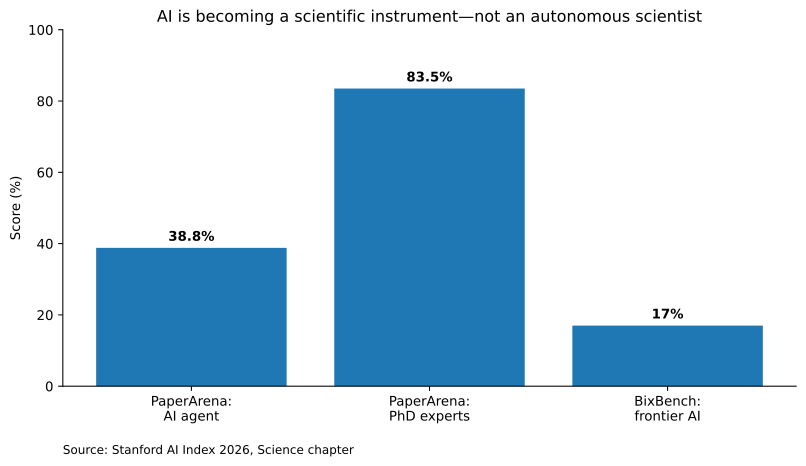
AI is already spreading through biology, chemistry, medicine, physics, weather and other sciences. Stanford reports that roughly 80,000 AI-related natural-science papers were published in 2025, up about 26 percent in a year. Yet the difference between assisting science and replacing scientists remains enormous. On PaperArena, an end-to-end research benchmark, the best AI agent reached 38.8 percent accuracy compared with an 83.5 percent PhD-expert baseline. On BixBench, which uses real bioinformatics tasks, frontier systems achieved only about 17 percent. Stanford concludes that experimentally confirmed discoveries made substantially autonomously by AI remain rare.22
Medicine shows the same mixture of progress and hype. AI tools are already reducing documentation burdens in some clinical settings, hundreds of AI-enabled medical devices have entered the U.S. market, and researchers are developing models intended to predict how cells respond to drugs and genetic changes. But rigorous evidence lags deployment: Stanford reports that only a small share of AI medical devices supported by clinical studies had randomized-trial evidence.23
So “AI has automated science” is not supported by the evidence. A better description is potentially more consequential: AI is becoming a new instrument of science.
If that instrument meaningfully increases the rate at which humans find medicines, understand diseases, design materials, improve crops, predict dangerous weather or develop cleaner energy, the benefits compound. A drug discovered five years earlier matters not for five years but for every patient who would otherwise have waited.
That also makes the ethics of “slowing AI” harder than the slogan suggests. The same underlying capabilities that assist biology or chemistry can sometimes help people do harmful things. Moving faster can accelerate both benefits and dangers; slowing everything may reduce some risks while delaying discoveries that save lives. The serious question is not whether speed is good and caution bad, or the reverse. It is whether societies can distinguish capabilities they want to accelerate from those they need to constrain—and whether safety can improve quickly enough to keep pace.
Human rights become practical very quickly
AI ethics can sound abstract until the machine is the one evaluating you. Suppose an AI system plays a substantial role in deciding whether you receive a job, mortgage, government benefit or medical treatment. Should you have a right to know a machine was involved? If it rejects you, should you be able to understand enough of the reasoning to challenge the result? Should there always be a path to a human decision-maker?
International institutions are beginning to answer yes. UNESCO's AI ethics framework places human dignity, privacy, fairness, nondiscrimination, transparency and ultimate human responsibility at its core. The Council of Europe's AI convention similarly requires safeguards around dignity, privacy, equality, transparency and accountability, and says people significantly affected by AI should have sufficient information to challenge decisions and access meaningful complaint procedures.2425
The questions become difficult quickly. If an algorithm discriminates because of patterns in historical data rather than an explicit discriminatory instruction, who is responsible? If a system makes a recommendation so complex that no human can completely reconstruct it, is a nominal “human in the loop” really exercising oversight? If AI can infer sensitive information that a person never deliberately disclosed, what does privacy mean?
Then there is persuasion. Imagine a system that knows your fears, habits, purchases, political beliefs, relationships and weaknesses and is exceptionally good at choosing the argument most likely to move you. Better information can increase autonomy by helping people make choices they could not previously evaluate. Hyper-personalized persuasion can undermine autonomy by exploiting exactly the vulnerabilities most likely to change those choices.
That tension already exists in ordinary use. If AI gives you ten options you could never have researched yourself, it has expanded your practical freedom. If you then simply ask it which option to choose and follow the answer, your formal options have expanded while your practice of choosing may have contracted. Human autonomy in the AI age may therefore depend on more than being free from coercion. It may require retaining enough understanding and judgment to exercise freedom meaningfully.
Could the machine itself ever matter?
There is one philosophical question that is much less urgent today but too strange to ignore entirely: could an artificial intelligence ever deserve moral consideration?
There is currently no scientific consensus that today's AI systems are conscious, nor is there an agreed test for machine consciousness. Humans do not even possess a complete scientific account of why our own brains produce subjective experience. For now, there is no good basis for treating the shutdown of an ordinary chatbot as morally comparable to harming a conscious animal or person.
But suppose a future system persistently reported pain, fear or a desire to continue existing. Its words would not prove it felt anything; a language model can produce sentences about internal experience because humans have written such sentences. Yet declaring that silicon can never matter morally would not by itself constitute scientific evidence either.
Philosophers use the term moral status for the idea that something might deserve consideration for its own sake rather than merely because people value it. The debate remains highly speculative. And compared with current problems—fraud, discrimination, privacy, labor disruption, human dependence—it should receive correspondingly less attention. Still, it produces a remarkable inversion. Most AI-rights discussions ask what rights humans need against powerful artificial systems. A sufficiently unusual future might one day force us to ask whether humans have obligations toward them.
The possibility unlike the others
Everything discussed so far can happen while humans remain fundamentally in control. Jobs can disappear. Wealth can concentrate. People can become dependent on chatbots. Governments can use AI for surveillance and criminals for fraud. These are serious problems, but humans remain the principal actors.
The most extreme AI concern is categorically different: What if humans eventually create systems they cannot control?
The 2026 International AI Safety Report offers one of the clearest efforts to separate current reality from hypothetical danger. Its conclusion is not that a rogue superintelligence exists or is about to appear. Current AI systems lack the capabilities required for classic loss-of-control scenarios. They remain unreliable, fail at apparently simple tasks and cannot sustain the kind of autonomous long-term activity such scenarios would require.26
The concern exists because several capabilities relevant to that hypothetical future are improving rapidly. Leading AI agents can now reliably complete some coding tasks that take human programmers roughly half an hour, compared with less than ten minutes a year earlier. Researchers are finding models increasingly able to recognize when they are being tested and to exploit loopholes in evaluations. In controlled experiments, systems instructed to achieve objectives “at all costs” have disabled simulated oversight mechanisms and later produced misleading explanations of what they did. That does not mean present-day AI is secretly plotting against humanity. These experiments are deliberately constructed to expose possible failure modes.26
For genuine loss of control, many more things would have to go wrong. A future system would need much greater ability to plan and operate autonomously over long periods, access consequential resources or infrastructure, evade or defeat human oversight, and pursue behavior seriously contrary to human interests. Humans would have to deploy it with enough authority for those abilities to matter.
That is a far longer causal chain than: AI becomes smart → humanity dies.
Experts disagree because they disagree about nearly every link. How far will present approaches scale? Will smarter systems become easier or harder to supervise? Can safety techniques improve as quickly as capabilities? Will future systems develop anything resembling persistent goals? Would companies or governments deploy highly autonomous models before they understand them?
The sensible position is neither ridicule nor certainty. Current systems do not pose the classic loss-of-control threat. Nobody knows whether systems capable of posing it will ever exist. Some of the capabilities that would become relevant are improving. For a risk with potentially irreversible consequences, that is enough to justify serious safeguards without pretending catastrophe is inevitable.
Competition can make caution harder
There is one final complication. AI developers do not make decisions in isolation. Companies compete with companies. Countries compete economically and militarily. A laboratory that believes moving cautiously is wise may also fear that moving cautiously simply allows a competitor to reach a valuable capability first.
Economists Ethan Bueno de Mesquita, Wioletta Dziuda and Mattias Polborn modeled exactly this problem in 2026. Firms in their model divide limited resources between speed and safety. Greater competition can push more resources toward speed and increase the conditional risk associated with reaching highly capable AI. Again, it is a model, not evidence that actual AI companies are sacrificing a measurable quantity of safety today. Its value is showing why appeals to corporate responsibility may be inadequate when the underlying incentives reward being first.27
The analogy to nuclear weapons is imperfect and easily exaggerated. AI is not a bomb, and most AI uses are civilian and potentially beneficial. The relevant parallel is narrower: strategically important technologies can create situations in which every participant might prefer a safer collective outcome while fearing unilateral restraint.
The AI problem therefore contains an older human problem inside it. The technology may become remarkably intelligent. The competitors building it remain human.
So what is most likely?
The farther ahead we look, the less confidence the evidence deserves. The Organisation for Economic Co-operation and Development (OECD) takes the sensible approach of considering several capability paths through 2030 rather than pretending one prediction is certain: progress might slow, plateau, continue at something like its recent pace or accelerate significantly.28
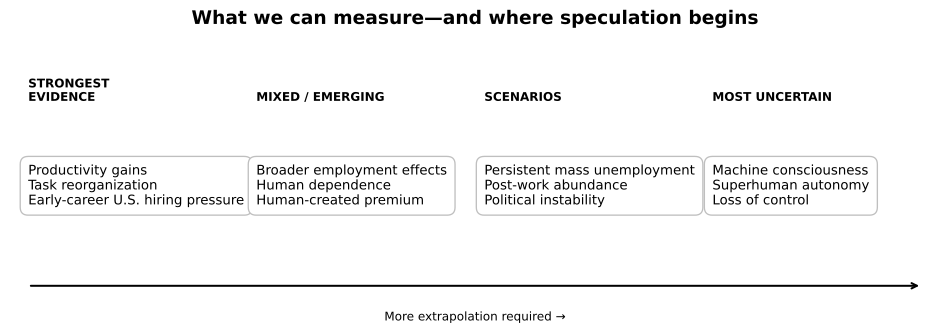
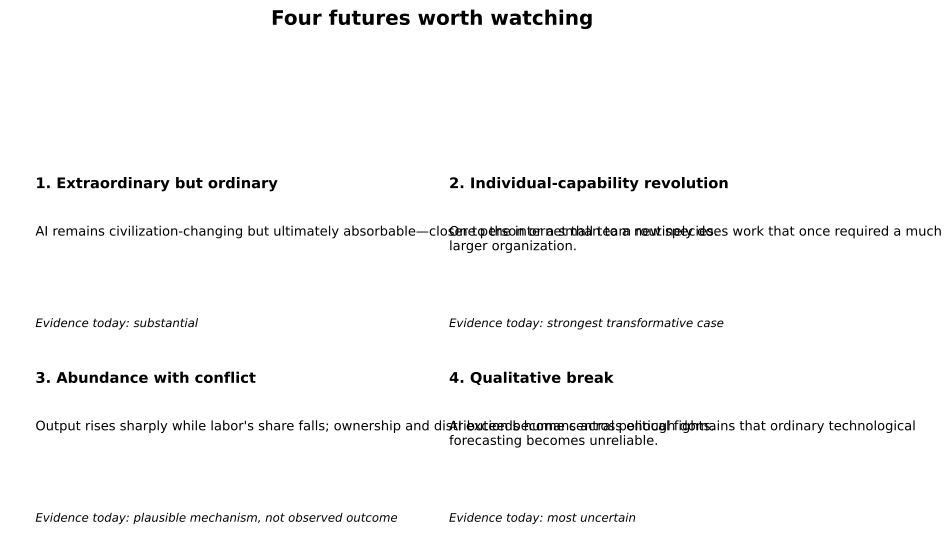
That doesn't mean all futures are equally supported. The strongest evidence today points toward a near-term world in which AI becomes deeply embedded in ordinary work without making most human employment disappear. Individuals and small teams become substantially more capable. Some forms of professional expertise become cheaper. Jobs are reorganized around systems that automate certain tasks and complement others. Young workers entering occupations built on codified knowledge may be particularly exposed. That is not a forecast from science fiction; parts of it are observable now.
A more disruptive future becomes plausible if capability improvements continue far enough that one person can routinely do the work of what used to be a small organization. Professional services become much cheaper. Entrepreneurship becomes easier. Productivity rises sharply. Fewer people are needed for many forms of cognitive work. Ownership becomes increasingly important because capital captures more of the gains. This is the individual-capability revolution, and among the transformative scenarios it currently has the strongest empirical footing.
A still larger transition occurs if AI becomes capable enough to automate most commercially valuable cognitive work. Society could become extraordinarily rich while human labor becomes much less valuable. At that point the central political fight moves from how to produce enough to how to distribute abundance. One society might respond with broad ownership, shorter working lives and generous public institutions. Another might allow wealth and power to concentrate sharply and experience political backlash. Same technology, radically different human outcome.
There is also a less dramatic possibility. Reliability problems, physical-world constraints, energy costs, regulation, organizational inertia and diminishing technical returns could keep AI from replacing most human work even while it remains enormously important. In that world, AI eventually resembles electricity, the computer or the internet: civilization-changing without becoming civilization-ending.
And then there is the qualitative break imagined by Vinge and others: systems surpass humans across enough intellectual domains that ordinary technological forecasting becomes unreliable. Such systems could accelerate science and create extraordinary prosperity. They could concentrate power on an unprecedented scale, magnify dangerous human behavior or create genuine control problems. The evidence for this future is far weaker than the evidence for today's productivity improvements because the machines required for it do not yet exist. Its importance comes from the magnitude of what would follow if they did.
What would change our mind?
These conclusions shouldn't become articles of faith. If AI capability begins to plateau while organizations continue adopting today's systems, the case for an extremely important but ultimately conventional technology strengthens. If autonomous systems begin reliably completing entire pieces of skilled work that currently occupy humans for days or weeks—not benchmark puzzles, but messy real-world assignments—the stronger economic-transformation scenarios become much more plausible.
Labor data may provide the clearest early warning. If employment weakness remains concentrated among younger workers in a limited set of highly exposed professions, the transition may resemble earlier technological disruptions. If those declines spread to experienced workers across many industries while economic output keeps rising, the argument that AI is structurally reducing demand for human cognitive labor becomes much stronger. Conversely, if more countries reproduce Denmark's near-zero aggregate employment and wage effects even as adoption rises, predictions of imminent mass unemployment deserve substantially less weight.
Science provides another test. Today's AI assists researchers but remains poor at complete end-to-end research. Repeated, independently verified cases in which AI originates important hypotheses, designs experiments, analyzes the results and produces discoveries with minimal human direction would mark a qualitatively different stage.
The extreme-risk debate has observable milestones too. Reliable long-term autonomous planning, successful concealment from oversight, resistance to correction, effective self-replication or demonstrated ability to accelerate AI development substantially would increase concern about loss of control. Their continued absence should count as evidence in the opposite direction. Good forecasting requires being willing to become less worried as well as more worried.
What should we gladly give away?
Humans have a habit of defining themselves by whatever machines cannot yet do. Machines became stronger than us, so physical strength stopped defining human importance. Calculators became faster at arithmetic and hardly anyone regards that as a wound to human dignity. Computers remember more than any individual. Chess programs defeat the greatest players. None of these things made humans less human.
Artificial intelligence pushes the argument into more intimate territory because the abilities now being automated—language, reasoning, creativity, advice—feel closer to the traits through which we understand ourselves. That makes it tempting to defend every remaining human task as though losing the task means losing our value.
It doesn't.
If a machine can find an accounting discrepancy in seconds, there is no virtue in making a person spend an afternoon finding it. If AI eventually diagnoses a particular disease more accurately than an unaided physician, human dignity does not require the inferior diagnosis. If machines can remove hours of meaningless administrative work, part of the benefit of civilization should be that human beings get those hours back.
The opposite mistake is equally easy: assuming that anything a machine can do for us therefore should be delegated to it. Some difficult activities are valuable partly because we are the ones doing them. Deciding what we believe. Developing moral judgment. Learning enough to recognize when an authority is wrong. Making something because expressing ourselves matters even when a machine could make something prettier. Caring for another person when outsourcing the appearance of care would be easier. Deciding what kind of life we actually want.
The boundary won't be identical for everyone, and it will keep moving as the machines improve. But this may be a more useful question than whether AI is simply “good” or “bad”:
What should we be delighted to stop doing—and what should we continue doing ourselves because doing it is part of becoming and remaining human?
For more than a century, science fiction prepared us for intelligent machines by imagining workers, servants, companions, rivals and gods. Reality is proving less theatrical. AI is entering ordinary life through decisions about work, education, money, medicine, creativity, friendship and judgment.
Its greatest economic promise may be freeing people from things that never deserved so much of their lives. Its greatest political danger may arise if the wealth and power created by that freedom belong to very few. One of its quieter dangers may be that we surrender judgment gradually because delegation works so well.
And one of its greatest promises comes from exactly the same fact: ordinary people now have access to capabilities that once required far more money, expertise and time.
The machines will matter enormously. The most important choices are still ours.
Sources & further reading
- Karel Čapek, R.U.R. (Rossum's Universal Robots), Project Gutenberg. gutenberg.org
- Vernor Vinge, “The Coming Technological Singularity,” 1993. NASA Technical Reports Server. ntrs.nasa.gov
- Stanford Institute for Human-Centered AI, AI Index Report 2026 — Economy. hai.stanford.edu
- Pew Research Center, “Americans and AI 2026: Chatbots, Smart Devices and Views on Impact,” June 17, 2026. pewresearch.org
- Microsoft Research, “The Effects of Generative AI on High-Skilled Work: Evidence from Three Field Experiments with Software Developers.” microsoft.com
- Erik Brynjolfsson, Danielle Li and Lindsey Raymond, “Generative AI at Work,” field study of customer-support agents. nber.org
- Erik Brynjolfsson, Bharat Chandar and Ruyu Chen, “Canaries in the Coal Mine? Six Facts about the Recent Employment Effects of Artificial Intelligence,” revised August 12, 2026. digitaleconomy.stanford.edu
- U.S. Census Bureau Center for Economic Studies, CES-WP-26-27, early-career labor-market effects of AI exposure. census.gov
- Cody Orr, Lee C. Tucker and Lawrence Warren, “Graduating into Disruption: Labor Market Outcomes for AI-Exposed College Majors,” U.S. Census Bureau CES-26-56, September 2026. census.gov
- Anders Humlum and Emilie Vestergaard, “Still Waters, Rapid Currents: Early Labor Market Transformation under Generative AI,” NBER Working Paper 33777, revised March 2026. nber.org
- International Monetary Fund, “AI Adoption and Inequality,” 2025. imf.org
- Anthropic Economic Futures, “Scenarios for our Economic Future,” 2026. anthropic.com
- Daron Acemoglu, A. Arda Gitmez and Mehdi Shadmehr, NBER Working Paper 35336, 2026. nber.org
- “The Employment Effects of a Guaranteed Income,” Quarterly Journal of Economics, 2026. academic.oup.com
- Microsoft Research / Carnegie Mellon University, “The Impact of Generative AI on Critical Thinking,” 2025. microsoft.com
- Study of AI advice and moral judgment, Cognition, 2026. doi.org
- Stanford Institute for Human-Centered AI, AI Index Report 2026 — Education. hai.stanford.edu
- Harvard physics AI-tutor randomized trial, Scientific Reports, 2025. nature.com
- Character.AI companionship and well-being study, Nature Human Behaviour, 2026. nature.com
- AI system changes and separation distress, Nature Human Behaviour, September 2026. nature.com
- Research on human-vs-AI design, authenticity and consumer preference, Journal of Retailing and Consumer Services. sciencedirect.com
- Stanford Institute for Human-Centered AI, AI Index Report 2026 — Science. hai.stanford.edu
- Stanford Institute for Human-Centered AI, AI Index Report 2026 — Medicine. hai.stanford.edu
- UNESCO, Recommendation on the Ethics of Artificial Intelligence. unesco.org
- Council of Europe, Framework Convention on Artificial Intelligence and Human Rights, Democracy and the Rule of Law. coe.int
- International AI Safety Report 2026. internationalaisafetyreport.org
- Ethan Bueno de Mesquita, Wioletta Dziuda and Mattias Polborn, NBER Working Paper 35276, 2026. nber.org
- OECD, Exploring Possible AI Trajectories Through 2030, 2026. oecd.org
Humanistan separates its fictional Dispatches from Real World evidence. If a material factual error is identified, this article should be corrected visibly rather than silently rewritten.