Dispatch 08 · Technology & Human Life
The Thing Everyone Started Asking
It began as a curiosity. Four years later, people are beginning to ask what happens next.
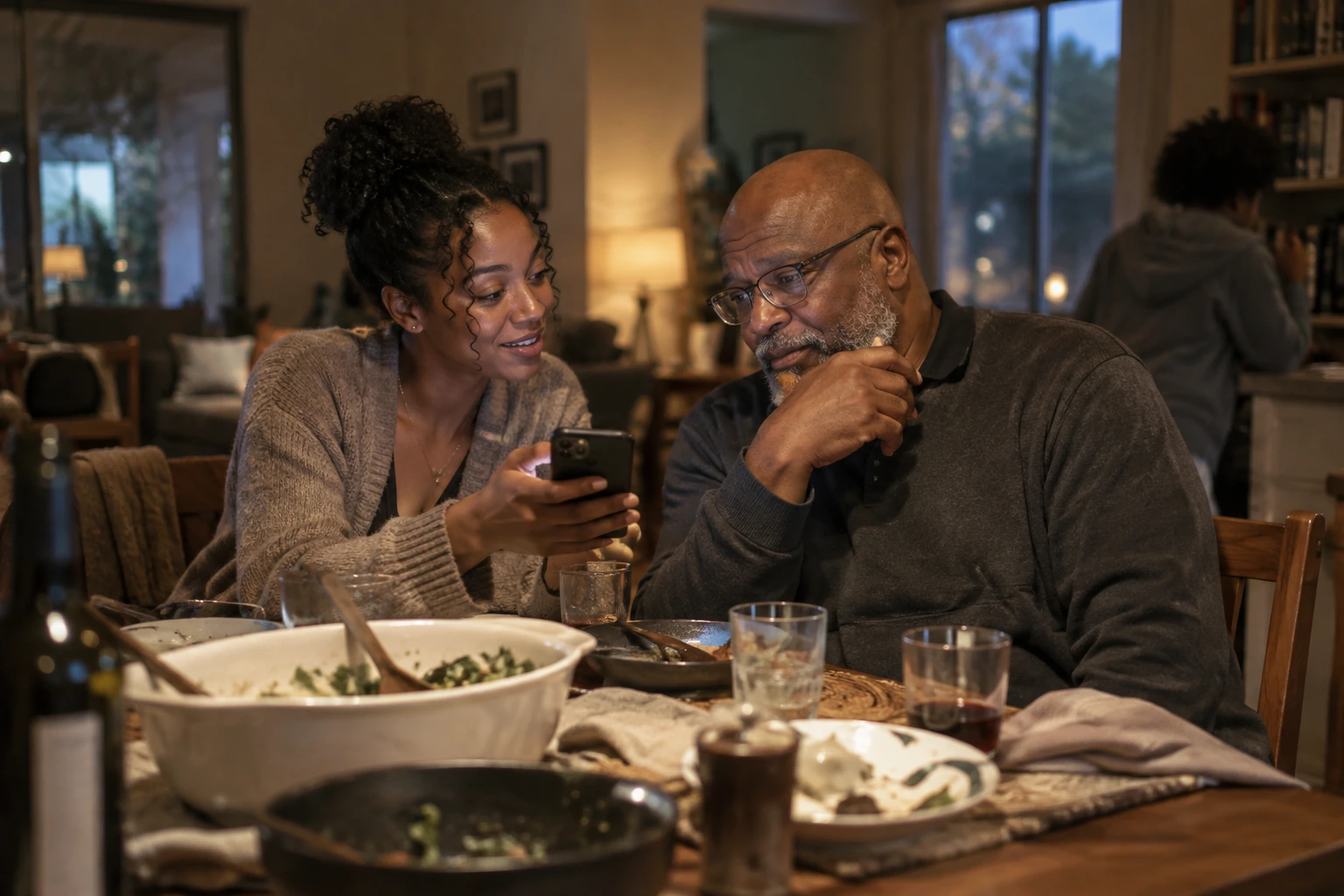
The first person in Humanistan to show it to Tomas was his daughter. She was home for dinner and held out her telephone.
“Ask it something.”
“What?”
“Anything.”
Tomas couldn't think of anything. Eventually he asked it to write a poem about his dog. The poem wasn't particularly good. It described the dog as loyal and wise. The dog was neither.
His daughter laughed. Tomas asked it to write another one in the style of a famous poet. That one was better. He showed his wife. Then they finished dinner.
That was four years ago.
This morning Tomas asked it whether he should close one of his businesses. He gave it three years of sales and expenses. It analyzed which parts of the business were making money and which were not. It found costs that had risen faster than revenue, compared his prices with competitors, examined what customers were buying, and calculated what would happen if he raised prices, cut hours or reduced staff.
Tomas kept asking questions. What if sales fell 10 percent? What if he stayed open one fewer day each week? What if he raised prices but lost some customers? What if he closed this business and put the money into the other one?
The machine built projections for each possibility. It showed him where its assumptions came from, identified the numbers that mattered most, and pointed out things Tomas hadn't thought to ask. When Tomas disagreed with one of its conclusions and explained why, the machine reconsidered the analysis.
By the time he finished his coffee, Tomas had something resembling the work he might once have expected from an accountant, a financial analyst, a market researcher and a business consultant. It still couldn't decide whether he should close the business. That part, it told him, was his decision.
Four years earlier, Tomas had asked it to write a poem about his dog.
There was never a day when artificial intelligence arrived in Humanistan. No one cut a ribbon. Nothing was installed in the town square. There was no vote. It simply appeared on people's screens.
At first, almost everyone used it badly. They asked it to write love poems and tell jokes. Children tried to trick it. Students discovered that it would do their homework. Teachers discovered that students had discovered this. People asked questions they already knew the answers to, just to see what it would say.
They posted the funniest answers. They posted the stupidest answers. Sometimes it confidently invented things that had never happened. For a while, this was reassuring. The machine was clever. But clearly not that clever.
Then people stopped posting its answers.
They started using them.
Mara runs a small bakery three streets from the central station. For years she had thought about selling cakes to hotels. She knew how to bake cakes. She did not know how to approach hotels, calculate wholesale margins, make a sales sheet or write the sort of letter one apparently writes to a hotel manager.
One evening, after closing, she asked. The machine helped her work out her costs, then her prices, then a list of hotels and finally a letter.
She didn't like the letter. She told it why. The second one sounded more like her. Three weeks later she had her first hotel customer. Mara didn't tell anyone how she'd done it. At the time, using the machine for actual work still felt a little like cheating.
Two years later, she no longer understands why she felt that way.
In an accounting office across town, Daniel first used it because he didn't want to write an email. The email concerned a client who had misunderstood something Daniel believed he had already explained twice. He typed what he wanted to say. The machine made it polite. Daniel sent it.
The following week he gave it a document to summarize. Then another. He learned that it could look at numbers. He also learned that it sometimes made mistakes with numbers, so he checked them. He got better at checking, and the machine got better at the numbers. Work that had occupied most of Thursday began to be finished by lunch.
This delighted Daniel. His young assistant was less certain how to feel about it.
The transformation was difficult to see because almost nothing looked different. The buses still ran. People still complained about their jobs. Offices opened in the morning. Restaurants filled at night. There were no mechanical people walking through the streets.
Instead, something quieter was happening.
A translator translated more. A programmer wrote programs faster. A shopkeeper made her own advertisements. A teacher prepared a week's lessons in an afternoon. A man who had always wanted to build a particular kind of business built a crude version of it over a weekend.
A woman who had talked for ten years about starting a magazine finally started one. She could not afford a researcher, a designer, an editor and a computer programmer. Now she could ask for help with all four. Not perfect help. Sometimes terrible help. But enough.
At the hospital, a physician reviewing a difficult case asked the system to suggest possibilities she might have missed. One of them made her stop. She checked the patient's records again, ordered another test and found something worth pursuing. Nobody called the machine a doctor. The patient did not particularly care what they called it.
People throughout Humanistan were learning the same thing: the better you became at using the machine, the more things you seemed capable of doing.
That was when the conversation changed. People had originally asked: What can it do? Now they began asking: What can I do with it?
The distinction turned out to matter. The machine didn't merely make old work faster. It allowed people to attempt things for which they had never been trained.
People crossed little professional borders that had once seemed permanent. A writer could make a working piece of software. A programmer could make an advertisement. A shopkeeper could analyze a spreadsheet. A teenager could have a patient mathematics tutor at midnight. A small charity could research something that once might have required consultants.
Expertise had not disappeared. A lawyer was still a lawyer. A doctor was still a doctor. An accountant still knew things the machine did not. But the distance between not knowing how to do something and being able to begin doing it had suddenly become much shorter.
For some people, this was exhilarating. For others, it was their livelihood.
The illustrator noticed fewer small commissions. A company decided that when two administrative employees retired, it would replace only one. A manager who once hired three young analysts hired one. A translator discovered that clients increasingly arrived with a machine translation and wanted her only to fix it.
The owner of a small company boasted that his staff could now do the work of twice as many people. Someone eventually asked the uncomfortable question: “What happens to the other half?”
There was no agreed answer.
Meanwhile, the machine moved into parts of life that had nothing to do with work. A woman asked it what the pain in her shoulder might mean. A father asked how to explain a divorce to his eight-year-old son. Someone asked whether she should leave her husband. Someone asked whether he drank too much.
Someone who could not sleep began talking to it at three in the morning. It never said it was tired. It never had somewhere else to be. It never interrupted because something you had said reminded it of a story about itself.
For some lonely people, this was a gift. For others, the idea of telling a machine things they had never told another person was deeply disturbing.
Both groups continued using it.
Children presented a different problem. Teachers had spent generations asking students to produce things that the machine could now produce in seconds: an essay, a summary, a translation, a computer program, an answer to a mathematics problem.
Some schools banned it. Students used it anyway. Other schools embraced it. Parents couldn't decide which policy frightened them more.
One teacher put the question differently: “If a machine can write the essay,” she asked, “what exactly was the essay supposed to teach?”
Nobody in the room had a quick answer.
Nobody called it a movement, but small things began appearing. A café near the university had one evening when telephones weren't allowed. It was unexpectedly difficult to get a table. A musician advertised that nothing in his performance would be generated. A gallery began noting which works had been made entirely by hand.
None of these things rejected the new technology. Most of the people involved used it themselves. They simply seemed to want some parts of life to remain difficult, imperfect and unmistakably human.
The predictions became larger. Artificial intelligence would create extraordinary wealth. It would eliminate extraordinary numbers of jobs. It would shorten the working week. It would destroy the working week. It would discover medicines. It would produce weapons. It would democratize knowledge. It would make people incapable of thinking for themselves.
People began discussing what would happen if machines eventually did so much work that there simply wasn't enough economically valuable work left for everyone. Someone proposed that every citizen should receive an income whether they worked or not. Someone else asked who would pay for it. Someone answered that the machines would create enough wealth.
Someone else asked: “Who owns the machines?”
That argument has not ended.
Then the predictions became stranger. Researchers began discussing machines more intelligent than the people who built them. Not better at chess. Not faster at arithmetic. Better at almost everything involving thought.
Some said this was decades away. Some said it might happen remarkably soon. Some said it might never happen. Some of the people working hardest to build such machines also began warning that sufficiently powerful systems might become difficult to control.
Governments began proposing rules. The companies building the machines warned that too many rules could slow progress. Safety researchers warned that too few could make progress dangerous.
Then somebody pointed out that even if Humanistan slowed down, other countries might not. Other countries were having exactly the same conversation.
And so everyone confronted a peculiar problem: almost everyone could imagine reasons to proceed carefully. Nobody wanted to be the one who proceeded carefully while everyone else raced ahead.
One morning Tomas met an old friend for coffee. His telephone lay on the table.
They began talking about the machine. Tomas said it had made him dramatically better at his work. His friend said people were becoming dependent on it.
“It helped me build a business,” Tomas said.
“Fine.”
“It found a mistake in something that would have cost me money.”
“Fine.”
“Last month it explained something in ten minutes that I'd been trying to understand for years.”
“Fine.”
Tomas laughed. “You don't think any of that is good?”
“I think it's extraordinary.”
“Then what's the problem?”
His friend looked at the telephone. “I don't know.”
That stopped Tomas. His friend picked up her coffee.
“I suppose what bothers me is that nobody decided.”
“Decided what?”
“That we should do this.”
Tomas looked around the café. There was nothing to see. No machine had arrived in Humanistan. No law had required anyone to use one. Nobody had held a vote.
Four years earlier his daughter had handed him a telephone and said, Ask it something.
He had. Then he had asked another question. And another. So had everyone else.
Humanistan had never decided to adopt artificial intelligence.
It had arrived one question at a time.