
Dispatch 01 · Culture & Memory
The Music Keeper
In one Humanistan town, dozens of songs still exist only because one old musician remembers them.
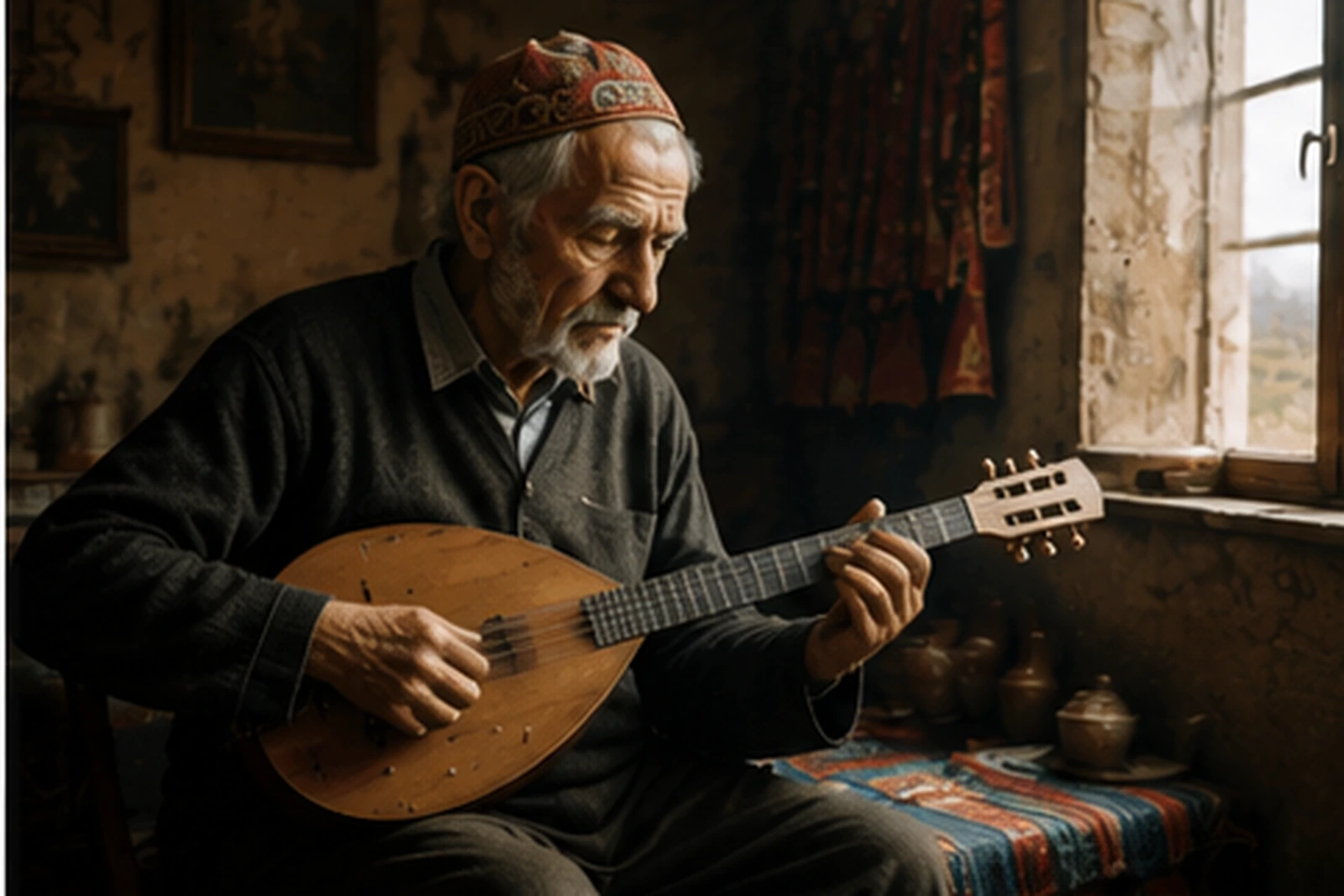
Nobody in the town calls him the Music Keeper. That is what we called him after three days of following people who kept pointing us toward the same narrow house at the end of the market road. His name is Oran. He is eighty-one, walks with a cane, and knows exactly how many songs he has forgotten: “Enough to bother me.”
The songs he still remembers were never rare when he was young. People sang them while repairing roofs, carrying food home, putting children to sleep and waiting for rain. There were songs for teasing a newly married couple, songs for men who stayed too long at the card table, songs whose verses changed depending on who happened to be offended that week. Nobody thought to write them down because nobody thought they were going anywhere.
Now there are fewer people who know the words. The work that accompanied some songs has disappeared. Families move. Children learn other music. Weddings have speakers. The town is not mourning all of this; most people seem pleased to have lighter work and louder parties. Culture can vanish without anyone voting to destroy it.
On the afternoon we visit, a younger musician named Sela sits across from Oran with a small recorder between them. She asks for a song about a river crossing. He starts twice, stops, laughs at himself and then plays it through. Halfway in, Sela quietly joins the refrain. Oran looks up. The song has already changed.
This is the difficulty with saving living traditions. A song is not a butterfly that can simply be pinned under glass. Record it and you preserve something. Teach it and it may become something else. Refuse to let it change and perhaps nobody will want to sing it at all.
Before we leave, Oran plays one more. He says his father sang it differently. His grandfather probably did too. “If nobody changes a song,” he says, “maybe nobody is singing it.”
What is being preserved, then: the exact notes, the memory of the people who sang them, the habit of singing together, or the permission for the next generation to make the song its own? Humanistan cannot answer that question. The real world has been wrestling with it for a very long time.